百思不得姐
Designation of Deutsche Bank as yuan-clearing bank in EU adds impetus to broader trade_我的网站

A |

A concept photo of currencies and financial market Illustration: VCG
The designation of Deutsche Bank, a key and influential bank in Europe, to serve as the yuan-clearing bank will greatly facilitate and expand the use of the yuan in the EU market, providing more impetus to broader China-EU economic and trade ties, a Chinese analyst said on Tuesday.
The People's Bank of China (PBC), the central bank, announced on Monday that it had decided to authorize Deutsche Bank to serve as the yuan-clearing bank in Frankfurt, Germany, based on a memorandum of understanding with the Deutsche Bundesbank.
The move came as China-EU trade and economic ties continue to deepen and bilateral trade continues to expand, despite recent restrictions imposed by the European Commission.
In a statement sent to the Global Times on Monday, Deutsche Bank said that following the appointment by the PBC, it will facilitate direct end-to-end processing, clearing and settlement services for cross-border yuan transactions for European financial institutions and businesses, acting as a local bridge to China's payment systems.
Deutsche Bank, a global systemically important bank as well as the world's largest euro-clearing bank, said that it is the first foreign bank in Europe to receive this designation.
"Securing yuan-clearing capability in Europe reinforces our role as a trusted global clearing partner and our long-standing support for yuan internationalization. It strengthens China-Europe financial connectivity and enhances our ability to support clients' cross-border trade and investment flows with greater choice and flexibility," Alexander von zur Muehlen, CEO of Asia Pacific, Europe, Middle East & Africa and Germany at Deutsche Bank, said in the statement.
Xi Junyang, a professor at the Shanghai University of Finance and Economics, told the Global Times on Tuesday that while a number of Chinese banks are already performing yuan-clearing functions in the EU, the addition of Deutsche Bank, with its deep roots in the local market, carries great significance.
"Banks have different client bases, and Deutsche Bank has many European companies as its customers. With the appointment, these market participants enjoy a far greater degree of facilitation and ease in tapping yuan use cases," said the professor.
Companies and financial institutions can also avoid risks of foreign exchange losses as they can now directly choose yuan-euro settlement and bypass the use of a third currency, the expert said, noting that China-EU trade and investment ties will be one step closer with a local clearing bank coming onboard.
Tian Lihui, dean of the Institute of Financial Development at Nankai University, told the Global Times on Tuesday that the latest development, some 12 years after the first-yuan clearing bank form a Chinese bank was set up in Frankfurt, marked a milestone as the yuan-clearing system in Europe has evolved from a model where "Chinese entities handle clearing for Europeans" to one where "Europeans handle yuan-clearing themselves."
The decision by one of Europe's largest domestic banks to integrate into the yuan-clearing system signals that China-Europe financial cooperation is moving beyond the shallow level of facilitating trade settlements into the more substantial level of jointly building financial infrastructure, Tian said.
For both China and Europe, this move represents a mutually beneficial institutional alignment, Tian said. "China gains greater depth in the offshore yuan market, while Europe secures an additional strategic option amid the contest of major currencies."
Brussels has recently been intensifying its use of restrictive trade and regulatory tools across sectors ranging from clean technologies to digital infrastructure and foreign subsidies, with many of these measures seen as directly affecting Chinese firms and adding strain to China-EU economic relations.
However, despite these moves, deepening industrial and supply chain integration and the strong complementarity of the two economies have continued to push bilateral trade to new highs. In the first seven months of 2026, China's total trade with the EU stood at 3.67 trillion yuan ($543.90 billion), up 9.5 percent year-on-year, data from China's General Administration of Customs showed on Friday.
As China-EU economic and trade ties continue to expand and deepen, demand for the yuan to be used in the EU market will rise proportionately, and more EU banks will likely be authorized to serve as yuan-clearing banks, Xi Junyang said.
Financial cooperation between the world's largest trading bloc and the largest trading nation has accelerated in recent months. In May, the PBC renewed and expanded a bilateral currency swap agreement with the National Bank of Serbia, increasing the value of the swap from 1.5 billion yuan to 5 billion yuan.
Almost 80 percent of the surveyed Chinese companies operating in the EU plan to expand their investment, even amid tightening policies in the EU and an increasingly complex business environment, according to a report published by the Chinese Chamber of Commerce to the EU and the China Economic Information Service in March. Fostering cooperation in emerging industries and cross-border finance have been highlighted by industry insiders as new growth drivers of China-EU trade and economic cooperation.
The yuan accounted for 3.1 percent of global payments in June, rising from 2.75 percent in the previous month, and ranking as the fifth most active currency for global payments by value, according to a report from the Society for Worldwide Interbank Financial Telecommunication. In terms of trade finance, the yuan ranked second with a market share of 8 percent.
。
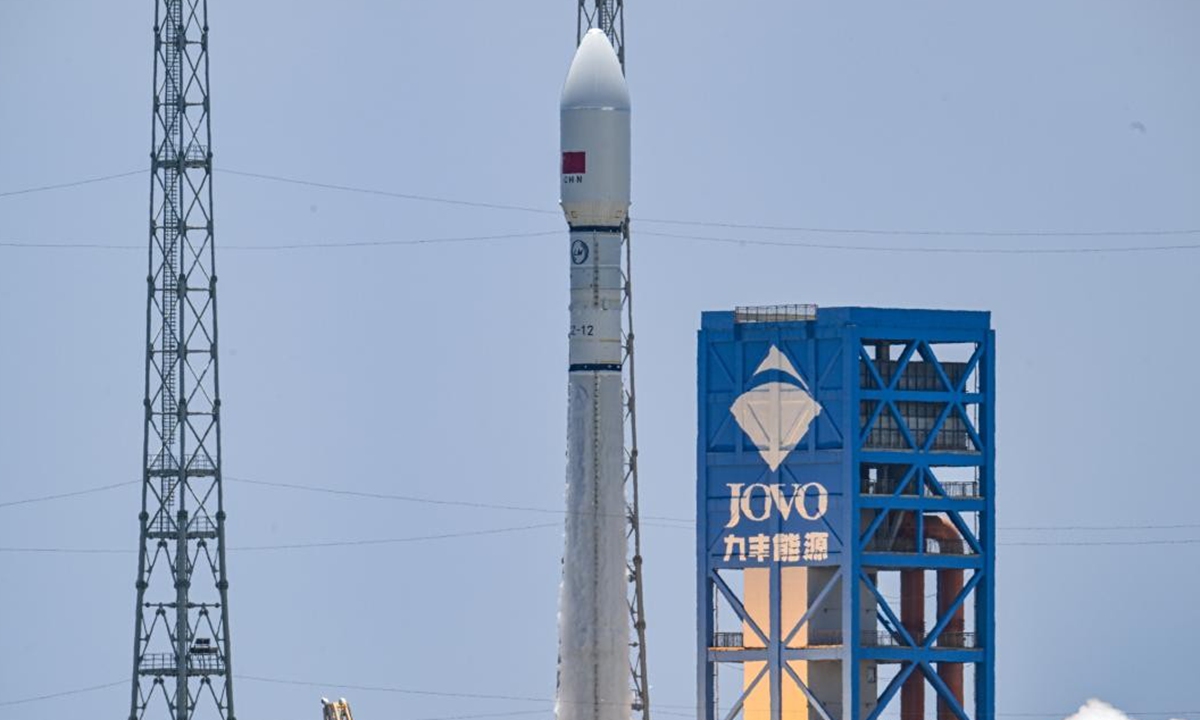
The 24th group of the low-orbit internet satellites aboard a Long March-12 carrier rocket is launched at 12:10 pm on August 16, 2026 from a commercial spacecraft launch site in the southern island province of Hainan. Photo: VCG
Two successful launches among China's recent frequent moves caught particular attention of space watchers - the 24th group of low-Earth orbit internet (LEO) satellites aboard a Long March-12 rocket was sent from a commercial spacecraft launch site in the southern island province of Hainan on Sunday, 12 days after the 23rd group of LEO satellites aboard a Long March-8A rocket was launched from the same Hainan site on August 4.
Sunday's mission marked the 663rd launch of the Long March series of carrier rockets, which on Monday sent an SEO satellite into preset orbit, per Xinhua.
Experts said the launches of two groups of LEO satellites within 12 days underlined that China is notably accelerating its pace of building its satellite internet constellation.
"The launch of LEO satellites has now entered a regular and cyclical rhythm, with batches of satellites continuously being sent into orbit at relatively stable intervals," Kang Guohua, a senior member of the Chinese Society of Astronautics and a professor of Aerospace Engineering at Nanjing University of Aeronautics and Astronautics, told the Global Times on Monday.
China launched the first group of LEO internet satellites on December 16, 2024, proceeding to the 24th batch in about 20 months. Kang said three major production and launch "assembly lines" are supporting the effort: satellite factories featuring centralized design in Beijing, coordinated supply chains and mass production; rockets with streamlined launch and testing procedures and multiple configurations; and launch sites capable of supporting routine constellation deployment.
The Long March-12, which played a key role in the latest LEO satellite launch, is China's first 4-meter-class single-core-stage carrier rocket and was specifically developed for commercial launch needs. It is about 62.6 meters long, has a liftoff mass of 430 tons and can carry more than 12 tons to low-Earth orbit. Its first stage is equipped with four 1,250-kilonewton pump-fed liquid oxygen-kerosene engines and uses a newly developed coal-based aerospace kerosene, according to Shanghai Academy of Spaceflight Technology.
The rocket adopts a "three-horizontal" launch preparation model: horizontal assembly, horizontal testing and horizontal transportation. Depending on mission requirements, it can use fairings with diameters of 4.2 or 5.2 meters and support both single-satellite and multi-satellite launches into different orbits.
"This flexibility makes the Long March-12 particularly suitable for the 'one rocket, multiple satellites' model required for constellation deployment, making it one of the main launch vehicles currently used for LEO constellation missions," Kang said.
The mission also highlighted the launch site's growing ability to support high-frequency launches. The rocket took only two and a half days from being transported to the launch area to liftoff, setting a record for the shortest time a rocket occupied the launch position at the site, Kang said.
Despite the rapid progress, experts cautioned that the 228 satellites currently in orbit remain some distance from the ultimate goal. China's satellite internet project has a long-term goal of deploying nearly 8,000 satellites and is now in an accelerated "weaving" phase.
China's advantage lies in its ability to control costs and boost production efficiency once satellite manufacturing reaches mass-production scale, another expert surnamed Liu told the Global Times.
"Whether it is the production capacity of AI centers or the factory in Hainan, which has an annual satellite manufacturing capacity of 1,000 units, satellite production itself is not the problem," Liu said. "More bottlenecks lie in the operational efficiency of launch pads and the rocket payload and recovery technology."
The real challenge lies in rocket reusability. Only by lowering launch costs and increasing launch frequency can China sustain a pace of more than one launch per week. This is also the strategic significance of accelerating the development of reusable rocket technology, including the Long March-10B and privately developed rockets, Kang further noted.
Chinese Academy of Engineering academician Deng Zhongliang previously said in an interview that satellite internet will serve as an indispensable space-time infrastructure for 6G, enabling emerging industries worth trillions of yuan, including the low-altitude economy, advanced autonomous driving and the Internet of Things (IoT).
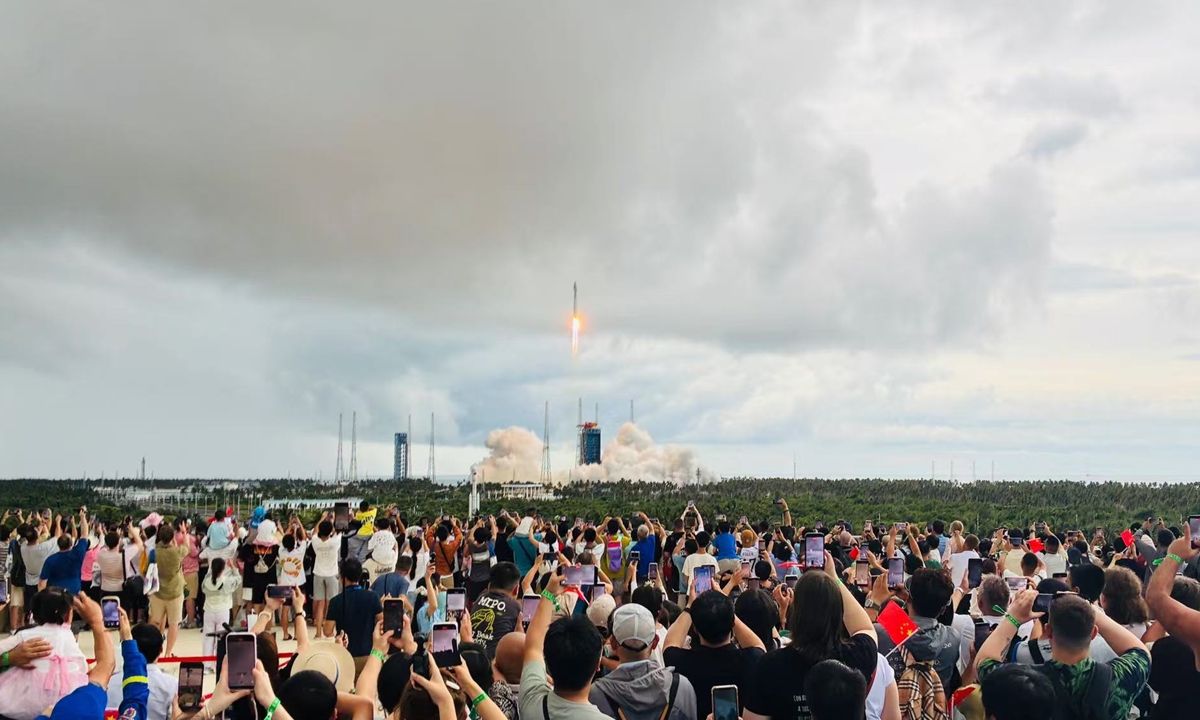
The 23rd group of low-orbit internet satellites aboard a Long March-8A carrier rocket is launched on August 4, 2026 from a commercial spacecraft launch site in the southern island province of Hainan. Photo: VCG
。
Current article:http://wd9.foujiongwenruapoumeizhan.buzz/gpwfbs/diizvml.html
Published on:03:40:43


